
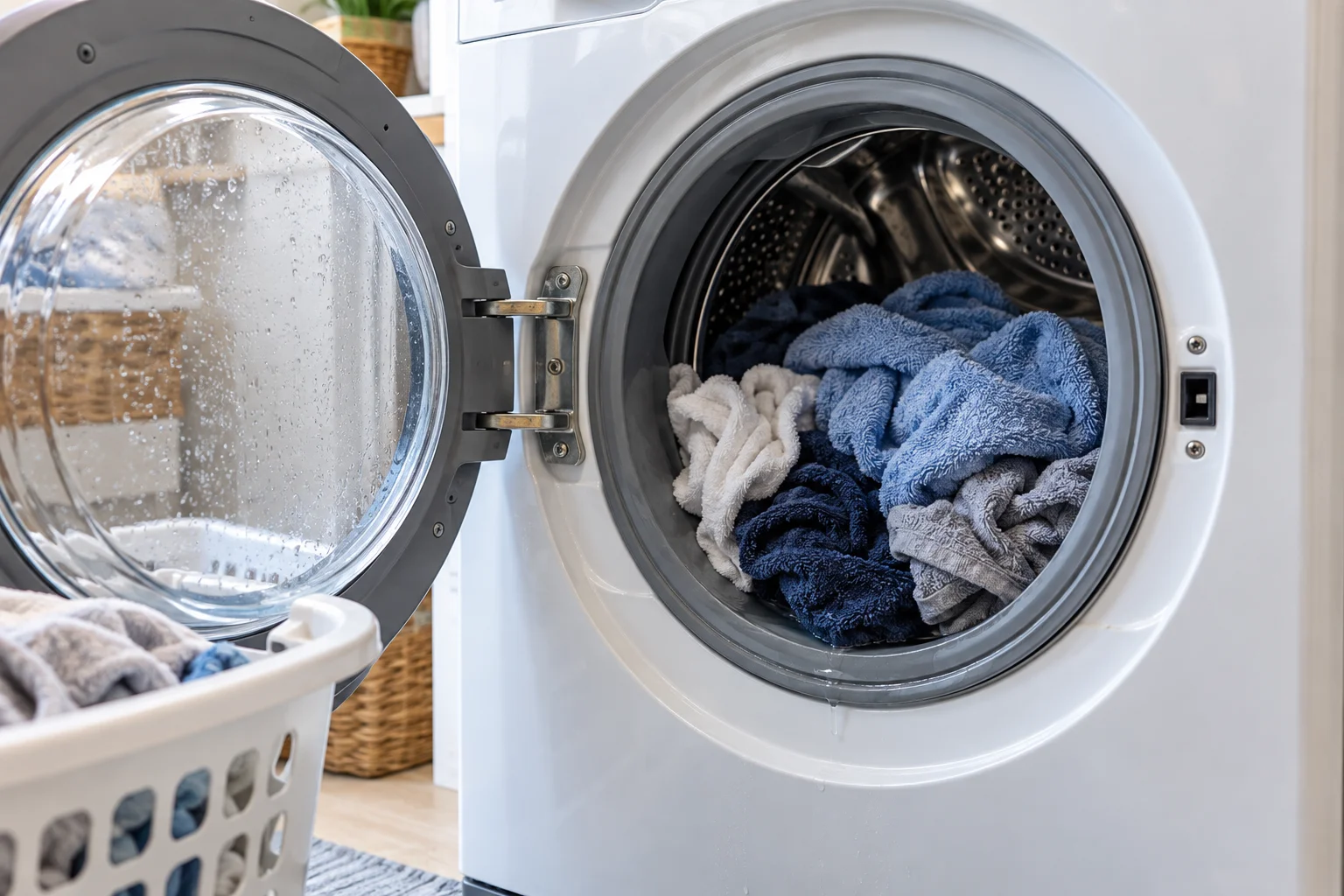
A washer not spinning may have an unbalanced load, incorrect cycle settings, a drainage restriction, a faulty door or lid switch, or a mechanical drive-system problem. Some issues can be resolved with simple checks, while others require professional repair.
A washer that will not spin at all may have a different problem from one that turns slowly or leaves clothes unusually wet. Start with the load, settings, and visible drainage conditions before assuming a part needs replacement.
This guide covers 10 common causes, safe troubleshooting steps, and when to call a technician.
Signs Your Washing Machine Is Not Spinning Properly
A washing machine increases basket speed during spinning to extract water from clothing. When spinning is interrupted or reduced, you may notice:
- Soaking wet clothes: Laundry holds substantially more water than expected after the cycle.
- No drum rotation: The machine may wash or drain but not rotate during the expected spin phase.
- Slow spinning: The basket turns without reaching its usual extraction speed.
- Excessive shaking: The machine vibrates or repeatedly reports an unbalanced load.
- An unfinished cycle: The washer stops or pauses before spinning is complete.
These signs help narrow the problem, but none identifies a specific failed part on its own. Consider whether the issue happens with every load or only with bulky laundry; that distinction can help explain the behavior to a technician. Let the basket stop completely before opening the machine, and never bypass its safety mechanisms.
10 Common Reasons Your Washer Is Not Spinning
The causes below range from loading issues to internal failures. Begin with checks that do not require opening the appliance cabinet.
1. Washing Machine Is Overloaded
Packing too many items into the drum restricts laundry movement and can trigger balance protection, causing some washers to slow or interrupt spinning. A full-looking drum is not necessarily overloaded; the manufacturer's stated load capacity and loading advice are more reliable guides.
Troubleshooting Tip: Wait until the washer stops and unlocks, remove a few items, and distribute the remaining laundry. Restart a suitable cycle following the owner's manual. If a smaller load spins normally, overloading may have contributed.
2. Laundry Load Is Unbalanced
Heavy towels, blankets, or bedding can bunch up on one side of the basket. Uneven weight distribution may cause shaking or repeated attempts to rebalance rather than reaching high spin speed.
Troubleshooting Tip: Pause the machine, wait until the drum stops and the door or lid unlocks, then spread items more evenly. Follow the manual's loading advice for bulky pieces.
3. Incorrect Cycle or Spin Speed Settings
Delicate and hand-wash programs commonly use gentler spinning to protect fabrics. Low Spin, Extra Low, or No Spin options can also leave more moisture in clothing without indicating a fault.
Troubleshooting Tip: Review the selected cycle and spin-speed setting. Choose a higher speed only when appropriate for the fabric and its care label. If the manual allows, try the recommended Drain & Spin program.
4. Washing Machine Is Not Level
An unstable washer may wobble as its basket accelerates. Excessive vibration can cause certain models to limit or stop spinning. A machine that repeatedly shifts across the floor needs attention even if it sometimes finishes the cycle.
Troubleshooting Tip: With the washer switched off, check whether it visibly tilts or rocks when gently pressed. Follow the manufacturer's leveling instructions. Avoid moving or lifting a heavy machine without help; persistent vibration warrants inspection.
5. Drainage Problems Prevent Spinning
Some washers delay or interrupt high-speed spinning until enough water has drained. Kinked hoses, blocked accessible filters, and malfunctioning pumps are possible washing machine drainage problems that can interfere with spin-cycle completion.
Troubleshooting Tip: Stop the washer and inspect visible hose sections for kinks. Before accessing a user-serviceable filter, disconnect power if it is safe to do so and follow the model's instructions. Retained water may be hot and can spill; prepare accordingly, and do not open a filter if water cannot be managed safely. Leave internal pump, electrical, and mechanical repairs to a technician.
6. Door Lock or Lid Switch Problems
Front-load washers generally use a door-lock system, while many top-load models use a lid switch or lock. If the washer does not detect a securely closed door or lid, spinning may be prevented. A latch warning is useful evidence, but it does not automatically establish which part is defective.
Troubleshooting Tip: Check that the door or lid closes normally and that no fabric is trapped. Note any error code and consult the owner's manual. Never bypass, manipulate, or disable a safety switch.
7. Excessive Detergent or Suds
Too much detergent, or the wrong type, may generate excessive suds and interfere with normal rinsing, draining, or spinning. High-efficiency models require particular attention to detergent type and quantity. Foam lingering after a rinse is a clue worth noting before changing mechanical parts.
Troubleshooting Tip: Use the detergent specified by the manufacturer, including HE detergent when required, and measure it as directed. If suds persist, follow the washer's recommended rinse or recovery procedure.
8. Power Failure or Interrupted Wash Cycle
An outage or interrupted wash program may stop the machine before the spin phase finishes. Some washers resume automatically; others need a restart. A single interrupted cycle is different from a machine that repeatedly stops at the same point.
Troubleshooting Tip: Check cycle status and displayed messages. Follow model-specific restart instructions or use Drain & Spin when permitted. If the appliance repeatedly loses power or trips a breaker, stop using it and arrange an electrical or appliance assessment.
9. Worn Clutch, Drive Belt, or Other Drive Components
Mechanical faults may interrupt spinning even when washing and draining still work. Depending on the design, a washer may use a belt, motor coupling, clutch, shift actuator, or related drive components. In models equipped with a clutch, wear can cause slipping as the basket engages and accelerates.
A completed Whirlpool washer repair in Roslyn Heights illustrates a clutch-related fault: the washer failed to spin, inspection found a worn clutch slipping during engagement, and replacement was followed by a successful spin-cycle test.
Troubleshooting Tip: If balancing, settings, and drainage checks do not help, request mechanical diagnosis. Do not dismantle the clutch, transmission, motor, or cabinet yourself.
10. Motor or Electronic Control Problems
A drive motor, motor-control component, sensor, or electronic control fault may prevent the drum from accelerating or completing its spin cycle. Exact components differ by model, and a displayed error code should be interpreted using the manufacturer's instructions rather than treated as a universal diagnosis.
Troubleshooting Tip: Record error codes and whether the washer washes, tumbles, or drains normally. Share these observations with a technician; internal electrical tests are not homeowner troubleshooting steps.
Why Is My Washing Machine Not Spinning Fast?
There is a useful difference between a basket that does not turn, one that rotates but never reaches full spin speed, and a completed cycle that leaves laundry unusually wet.
No rotation may point to a safety, control, or drive-related interruption. Slow rotation can follow a low-spin setting, imbalance, excess suds, drainage restrictions, or mechanical wear. Damp clothes alone do not prove a fault: delicate cycles and absorbent fabrics naturally retain more moisture.
Check the program and load before comparing spin performance. If appropriate settings repeatedly leave clothes soaking wet or the basket visibly struggles to accelerate, the washer may need inspection.
Front Load vs. Top Load Washer Spin Problems
Front-load and top-load machines both extract moisture by spinning, but their safety and drive systems differ.
Front-load washers typically use a horizontal drum and an electronic door lock. Depending on the model, the motor may drive the drum through a belt or a direct-drive arrangement.
Top-load washers use a vertical basket and may have a lid switch or lock, shift actuator, clutch, or other drive components. Clutches are used on certain designs, not every washer.
Drain access, diagnostic codes, and safe maintenance procedures also vary. For example, some machines have a user-accessible pump filter, while others do not. Use the exact model number and manufacturer instructions before assuming a component or troubleshooting step applies.
When Should You Call a Washer Repair Technician?
Basic loading and settings adjustments can help, but recurring symptoms call for professional evaluation. Consider service when the basket repeatedly fails to spin, error codes return, unusual grinding or clicking develops, or water remains in the tub. Stop using the washer if there is uncontrolled leakage, a burning smell, or an electrical hazard.
When a spin problem persists after safe checks, professional washing machine repair can identify the affected system before parts are replaced. Contact Technical Appliance Service LLC to request an inspection if your washer still will not spin properly.
The company's Long Island service coverage includes Nassau County communities and selected areas of Suffolk County.
Tips to Help Prevent Washer Spin-Cycle Problems
Good laundry habits and basic maintenance can reduce preventable spin interruptions:
- Avoid overloading the drum.
- Spread bulky items evenly and follow the manual's load guidance.
- Choose a suitable cycle and spin speed for each fabric.
- Measure the correct detergent type and amount.
- Maintain user-accessible filters only as instructed by the manufacturer.
- Check visible drain-hose sections for kinks.
- Take recurring vibration or error messages seriously.
These practices support normal operation but cannot prevent every mechanical or electrical failure.
Frequently Asked Questions
Why is my washing machine not spinning but still draining?
Draining and spinning rely on different functions. The pump may remove water while a door or lid safety mechanism, drive component, motor, or control issue prevents the basket from spinning. If basic settings and load checks do not resolve the problem, the washer may need professional diagnosis.
Why does my washer leave clothes soaking wet?
Clothes may remain soaked because spinning was too slow, the spin cycle ended early, or the machine did not drain fully. An unbalanced load or a low-spin setting can produce similar results. Check the selected program and whether water remains in the drum before assuming a mechanical failure.
Can a bad clutch stop a washing machine from spinning?
Yes. In models equipped with a clutch, worn parts can slip during engagement and prevent the basket from reaching normal speed. A clutch replacement may be appropriate when professional inspection identifies a clutch fault, but other problems can also cause spin failure.
Why does my washer spin slowly but not at full speed?
A low spin-speed setting, uneven load, excess detergent suds, or poor drainage can limit acceleration. Mechanical drive problems are another possibility. Start with the selected cycle and load distribution, then seek an inspection if the basket still cannot reach its expected speed.
Can I fix a washing machine that won't spin myself?
You can safely try some checks, including reducing an oversized load, redistributing laundry, reviewing spin settings, and inspecting visible hose kinks. Follow the model's instructions before accessing any user-serviceable filter. Electrical testing and internal clutch, motor, or safety-switch repairs belong with qualified technicians.