
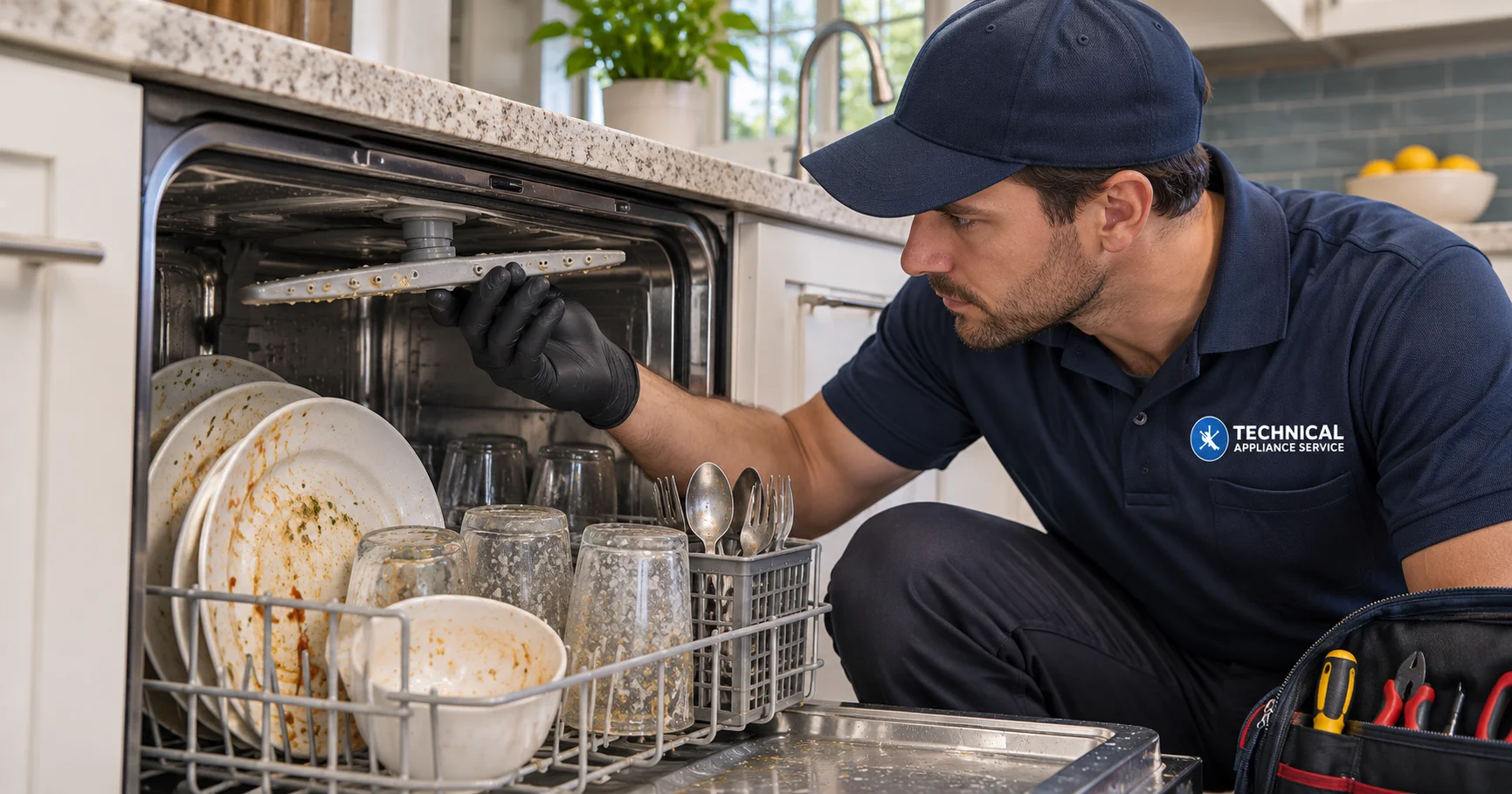
If you're wondering why your dishwasher is not cleaning dishes even after a complete cycle, common possibilities include a clogged filter, blocked spray arms, incorrect loading, detergent or cycle problems, and inadequate water conditions. An internal washing component may also need attention. Dirty dishes do not automatically mean the appliance must be replaced.
Pay attention to what remains after washing: dried food, a greasy coating, or cloudy white marks. Also notice whether the problem affects every dish or just one rack. Those differences can help you choose a safe first check without guessing which part has failed.
Dishwasher Not Cleaning? Match the Symptom to a Possible Cause
Each cause is a possibility, not a confirmed diagnosis; more than one issue can produce the same result.
| What You Notice | Possible Cause | Safe First Check |
|---|---|---|
| Food remains on many dishes | Dirty filter or obstructed spray arms | Inspect accessible filters and spray arms |
| Only the top rack remains dirty | Upper spray-arm or water-distribution issue | Check loading and spray-arm clearance |
| Plates feel greasy | Detergent, cycle, or wash-temperature issue | Review detergent and the selected cycle |
| Glasses have white marks or cloudiness | Minerals, detergent residue, or glass etching | Check rinse-aid and detergent guidance |
| Detergent pod remains intact | Blocked dispenser or inadequate washing conditions | Check dispenser clearance and pod condition |
| Washing is consistently weak | Insufficient water or an internal circulation issue | Note error codes; seek diagnosis if basic checks fail |
What Should You Check First?
Before examining individual causes, confirm that the dishwasher actually completed the selected wash cycle. A paused or interrupted program can leave dishes dirty even if the machine sounded as though it was running. Note any error messages and whether the problem started suddenly or has worsened over several loads.
Next, identify what remains on the dishes: stuck-on food, oily residue, white spots, or detergent. After the machine has stopped and cooled, switch it off and look for an unopened detergent dispenser, visible debris around user-accessible filters, and dishes or utensils blocking spray-arm movement.
If these basic checks do not explain why dishes remain dirty, professional dishwasher repair on Long Island can help identify whether a water-supply, circulation, or other internal problem is affecting cleaning performance.
Stop using the dishwasher if it is leaking, smells like burning, or shows signs of electrical damage. Do not run another test cycle until the unsafe condition has been assessed.
9 Reasons Your Dishwasher Is Not Cleaning Properly
1. A Dirty or Clogged Dishwasher Filter
A dishwasher filter catches food particles and debris so they do not keep circulating through the wash. Grease and scraps can build up and leave food particles on dishes.
Safe check: With the appliance turned off and cool, consult the owner's manual to find out whether your model has a removable, user-serviceable filter. If it does, remove and rinse it as instructed, using a soft brush if the manufacturer recommends one. Be cautious of broken glass or sharp debris. Reinstall the filter securely before using the machine. Do not remove fixed assemblies or reach into inaccessible components.
2. Spray Arms Are Blocked or Cannot Rotate
Spray arms direct wash water toward dishes on different racks. Food debris can block small spray openings, while tall cookware, serving utensils, or items hanging below a rack can physically obstruct arm movement. Either problem can leave some dishes with food stuck to them while others come out clean.
Safe check: Turn the appliance off, pull out the racks as permitted, and look for visible obstructions. Check that accessible spray arms can move without striking a dish or utensil. Follow the manufacturer's instructions if an arm is designed for removal and cleaning; do not force one off or insert tools that could damage it.
Persistent poor spray coverage can have other causes that require diagnosis.
3. Dishes Are Overloaded or Loaded Incorrectly
When plates overlap, bowls nest together, or pans shield smaller items, wash water may not reach every dirty surface. A large cutting board can also obstruct the detergent dispenser, while a long utensil may interfere with a spray arm. This is a common reason a dishwasher leaves food on dishes in one area but not another.
Safe check: Reload according to the appliance's rack diagrams, leaving room for water to circulate and for the dispenser to open. Face soiled surfaces toward the intended spray pattern, and keep large items away from moving parts. Follow your model’s loading instructions.
Whether dishes should be pre-rinsed depends on the manufacturer's guidance and the selected wash program.
4. Dishwasher Detergent Is Not Dispensing Properly
A detergent pod left in the dispenser, powder that has clumped, or greasy dishes after a full cycle can suggest a detergent-related problem. The compartment may have been blocked by a pan, the product may have absorbed moisture, or wash conditions may have prevented the detergent from dissolving and distributing properly. These clues do not establish that the dispenser itself is defective.
Safe check: Make sure nothing obstructs the detergent door when the racks are pushed in. Use only detergent intended for automatic dishwashers, follow the product and appliance dosing instructions, and replace detergent that has become damp or deteriorated. Review the manual's guidance on where to place pods.
Never substitute ordinary hand dishwashing liquid: excessive suds can interfere with operation and may overflow. Those suds are also one of the common reasons a dishwasher leaks from the door.
5. The Wrong Wash Cycle Was Selected
A quick, light, or rinse-only cycle may not be suitable for heavily soiled pots, baked-on food, or greasy plates. When the dishwasher is not cleaning properly, the issue may be a mismatch between the selected program and the load rather than a failed component.
Safe check: Compare the cycle selected with the manufacturer's recommendations for the dishes and the amount of soil. If your model has a rack-specific setting, confirm it was not selected unintentionally. A heavier cycle may be appropriate for certain cookware, but high-temperature or intensive programs are not suitable for every item. Check item care labels first.
6. The Water Temperature Is Inadequate
Wash-water temperature can affect how efficiently detergent works and how well grease loosens from dishes. Depending on the dishwasher design, a cool household hot-water supply or a problem with the appliance's heating system could contribute to poor cleaning.
Safe check: Confirm that hot water is normally available at nearby faucets. Some manufacturers recommend letting hot water reach the nearby sink before starting the dishwasher, but that advice is model-specific. Select an appropriate cycle according to the manual rather than assuming every machine requires the same inlet temperature.
Testing heating elements, thermostats, wiring, or controls should be left to qualified professionals.
7. The Dishwasher Is Not Receiving Enough Water
The wash system needs an adequate amount of water to distribute detergent and remove soil. Restricted water supply, a faulty inlet valve, or another filling or control problem can interfere with cleaning. However, a dirty load does not tell you which component, if any, has failed.
Safe check: Look for water-related error messages and confirm that household water service is functioning normally. If the dishwasher repeatedly seems to have weak washing action after other routine checks, arrange professional diagnosis. Do not disconnect supply fittings or access energized components yourself.
Water-supply problems can affect how well a dishwasher cleans. For example, during a dishwasher water valve replacement in Shirley, our technician replaced the water valve after the homeowner reported poor cleaning performance. However, the same symptom can have other causes, so proper diagnosis is important before replacing components.
8. Hard Water or Mineral Residue Is Affecting the Results
Hard-water minerals can leave white spots, and excess or poorly rinsed detergent can create a cloudy film. Distinguishing this residue from stuck-on food is important because cleaning the filter will not necessarily resolve mineral deposits.
Safe check: Review the detergent quantity, rinse-aid settings, and appliance-specific instructions for dealing with hard water. Use only cleaning products and procedures approved for your model.
Some cloudy glassware has been permanently etched. Etching is surface damage, not a removable film, and switching detergent will not restore the glass.
9. A Circulation or Internal Washing Component May Be Failing
If you have checked loading, user-serviceable filters, accessible spray arms, detergent, and the appropriate cycle but the dishwasher still barely washes, an internal circulation problem may be involved. Depending on the model, a wash pump, water-distribution mechanism, sensor, or control-related fault can affect cleaning performance.
Possible warning signs include unusually weak washing action, new mechanical noises during a wash, repeated error codes, or inconsistent results despite appropriate maintenance. These symptoms help a technician decide what to inspect, but they cannot identify a faulty part on their own.
Safe next step: Arrange a professional assessment rather than opening the dishwasher's electrical assemblies, testing live voltage, or replacing parts by trial and error.
Why Is My Dishwasher Not Cleaning the Top or Bottom Rack?
If both racks are dirty, consider issues affecting the whole wash. If only one rack stays dirty, focus first on how water reaches that level.
Dishwasher Not Cleaning the Top Rack
If the top rack of your dishwasher is not cleaning, check for cups nested too closely, a tall item interfering with the upper or middle spray arm, or a rack that is not seated as the manufacturer intends. Some designs route water to the upper spray assembly through model-specific connections; a problem there may need professional inspection.
Dishwasher Not Cleaning the Bottom Rack
When the bottom rack remains dirty, inspect whether large pans or plates are shielding the lower spray arm. Make sure utensils do not hang down into its path, and check any user-serviceable filter for debris. Review the chosen program, especially if your dishwasher offers rack-specific washing options.
If the issue persists, a technician can check water distribution.
When Does a Dishwasher Need Professional Repair?
Professional diagnosis becomes more useful when the same cleaning problem returns after the simple checks above. Consistently weak water circulation, unusual mechanical sounds, repeated error codes, or poor results despite correct loading and detergent may point to a problem beyond routine maintenance. Any active leak, burning smell, or suspected electrical fault is a reason to stop using the appliance until it is assessed.
We also handled a dishwasher cleaning problem in Westbury where the homeowner reported poor cleaning performance. Our technician completed the repair and resolved the reported issue. This example shows why persistent cleaning problems should be diagnosed rather than assuming a particular component has failed.
Frequently Asked Questions
Why is my dishwasher running but not cleaning dishes?
A dishwasher can complete its program without washing effectively if water cannot reach the dishes or the detergent is not working as intended. Check loading, a user-serviceable filter, accessible spray arms, the dispenser, and the chosen cycle. Water conditions or an internal circulation fault are other possibilities.
Why is my dishwasher not cleaning the top rack?
The upper rack may be overcrowded, or an item may block an upper or middle spray arm. Some models also rely on a rack-positioned connection to deliver water to the upper level. Check loading and spray-arm clearance using the owner's manual. If the top rack remains dirty despite those checks, the water-delivery system may need inspection.
Why is my dishwasher not cleaning the bottom rack?
Oversized cookware, closely spaced plates, or utensils hanging into the lower spray arm can restrict wash coverage. Debris in an accessible filter may contribute as well. Check the lower rack’s loading, spray-arm clearance, and selected cycle. If those checks do not help, seek a model-specific diagnosis.
Why is my dishwasher leaving white residue on dishes?
White residue may be mineral deposits from hard water or detergent that did not rinse away completely. Review the product amount, rinse-aid settings, and maintenance instructions for your model. Cloudy glasses can also be permanently etched, which looks similar to a film but cannot be removed by a cleaning cycle or detergent adjustment.
Why isn't my dishwasher detergent pod dissolving?
An intact pod may mean the dispenser door was obstructed, the selected cycle did not provide suitable wash conditions, or water did not reach the detergent as intended. A damp or deteriorated pod can also be a factor. Check how the racks are loaded, the dispenser's clearance, and the product's storage instructions before assuming a component has failed.
Should I repair or replace a dishwasher that is not cleaning?
That depends on the dishwasher's age, condition, available parts, the confirmed fault, and the cost of repair compared with replacement. Many cleaning complaints start with loading or maintenance issues and do not justify replacing the appliance. When an internal fault is suspected, a diagnosis and repair estimate can help you compare the options without guessing.
Dishwasher Repair Help for Long Island Homeowners
Technical Appliance Service LLC provides residential appliance repair throughout Nassau County and selected Suffolk County communities. Review the Long Island communities we serve to confirm coverage for your town. Our regular hours are 8:00 AM–7:00 PM daily; same-day appointments may be available depending on scheduling.
If your dishwasher continues leaving dishes dirty after the appropriate basic checks, schedule a dishwasher repair appointment or call +1 929-585-2342 to discuss the symptoms and availability.