
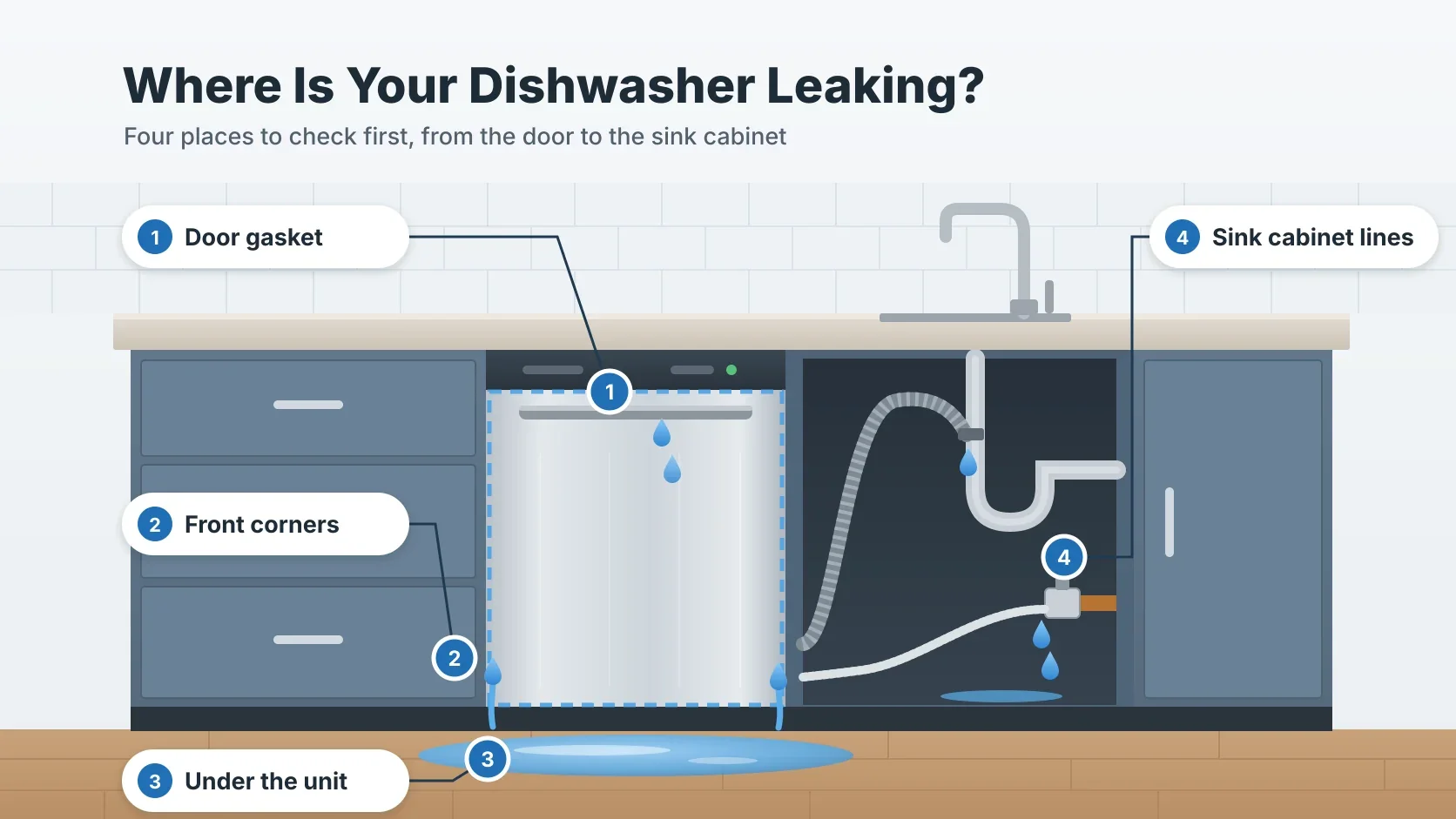
Dishwasher Leaking? Find the Cause by Where the Water Is
A dishwasher usually leaks for one of a few reasons: too many suds, a worn or dirty door gasket, a unit that is not level, or a loose water supply or drain connection underneath. Where the water appears, and when in the cycle it shows up, is the fastest way to narrow down the cause.
A small puddle can turn into swollen flooring or a damaged cabinet base if the dishwasher keeps running. This guide shows you how to stop the water, find where it is coming from, and decide what you can safely check yourself and what needs a technician.
First 10 Minutes: Stop the Water and Protect the Floor
Before you look for the cause, limit the damage:
- Stop the cycle. Cancel the wash and switch off the dishwasher's circuit at the breaker if water is near the unit's base.
- Close the water supply. Most dishwashers are fed by a small shut-off valve under the kitchen sink, usually on the hot water line.
- Dry the area. Soak up standing water with towels so it does not run under the cabinets or the floor.
- Take photos. Photograph the puddle, the floor and the cabinet base. They help a technician, and you may want them for your records.
- Do not run it again until you know where the water is coming from.
If water is still flowing after the valve is closed, the leak is probably not coming from the dishwasher. Check the sink drain, faucet lines and garbage disposal.
Where Is the Water Coming From?
Use this table to match what you see to the most likely causes.
| Where you see water | When it happens | Most likely causes | What you can check |
|---|---|---|---|
| Along the front edge or top of the door | During the wash | Too many suds, door gasket, tall item blocking the spray arm | Detergent type and amount; gasket condition; loading |
| Under the door, at the front corners | During or after the cycle | Worn lower door seal, dishwasher not level, door not closing tightly | Gasket and seal; level the unit; latch closes firmly |
| Under the dishwasher (puddle on the floor) | While it fills with water | Loose supply line connection, failing water inlet valve | Supply line fitting at the valve under the sink |
| Under the dishwasher | While it drains | Loose drain hose clamp, cracked drain hose, worn pump seal | Drain hose connection under the sink |
| Inside the sink cabinet | During drain | Drain hose loose at the garbage disposal or sink drain | Hose clamp and hose for drips |
| On the countertop or in the sink, near the faucet | During drain | Clogged air gap (if your sink has one) | Clean the air gap cap |
| On the floor when the dishwasher is not running | Any time | Supply line fitting, inlet valve that does not fully close, or a leak from the sink plumbing | Keep the valve closed and call for service |
| Standing water inside the tub | After the cycle | Not a leak; this is a drain problem | See our guide to a dishwasher that is not draining |
The paper towel test: with the power and water back on, lay dry paper towels under the front edge of the dishwasher and inside the sink cabinet. Run a short rinse cycle and stay nearby, but do not reach under the unit while it runs. Afterward, check which towels got wet. That tells you whether the leak is at the door, under the unit, or at the plumbing under the sink.
9 Common Reasons a Dishwasher Leaks
1. Too Many Suds From the Wrong Detergent
Regular hand dish soap creates a lot of foam. In a dishwasher, that foam can push past the door seal and spill onto the floor. Using too much automatic dishwasher detergent, or spilling rinse aid inside the door, can do the same.
What to do: use only automatic dishwasher detergent and follow the dose on the package. If suds are already in the tub, remove as much as you can before running a rinse cycle. Detergent problems also affect wash results, so read our guide on poor cleaning results if your dishes also come out dirty.
2. Worn, Dirty or Out-of-Place Door Gasket
The rubber gasket around the door keeps water inside the tub. Over time it can harden, crack or tear. Food residue and grease on the gasket can also stop it from sealing.
What to do: with the power off, wipe the gasket with warm water and a soft cloth. Look for cracks, flat spots or a section that has pulled out of its channel. A damaged gasket should be replaced with the correct part for your model.
3. The Dishwasher Is Not Level
If the dishwasher tilts forward or to one side, water can collect against the door instead of draining toward the sump. This often shows up after an installation or after the unit was pulled out and pushed back in.
What to do: place a level on the bottom rack rail or the door frame. If it is off, the front legs are usually adjustable. If the unit is fastened under the countertop, leveling may require removing the kick plate and brackets, which is a job for a technician.
4. The Door Is Not Closing Tightly
A bent or worn door latch, a weak door hinge, or a dish rack that sticks out can stop the door from sealing completely. Tall items such as cutting boards or baking sheets can also block the spray arm and spray water directly at the door vent.
What to do: close the door slowly and check that it latches firmly with no gap. Reload tall items along the sides or the back, and make sure the spray arms spin freely.
5. Loose or Damaged Water Supply Line
Water enters the dishwasher through a supply line that runs from the shut-off valve under the sink to the unit's inlet valve. A loose fitting or a worn line usually leaks while the dishwasher is filling, and the water appears underneath the unit.
What to do: with the valve closed, look at the connection under the sink for drips or mineral buildup. Do not overtighten fittings. The connection at the dishwasher end sits behind the kick plate, near electrical wiring, so leave that part to a technician.
6. Failing Water Inlet Valve
The inlet valve opens to let water in and closes when the tub has enough. A cracked valve body can leak during the fill. A valve that does not close fully can let water trickle in even when the dishwasher is off. In that case the tub can overfill and spill.
What to do: if you find water under the dishwasher when it has not been running, keep the supply valve closed and schedule a repair. For an example of this part being replaced, see our water inlet valve replacement in East Hampton.
7. Drain Hose or Hose Clamp Problems
The drain hose carries dirty water from the dishwasher to the sink drain or garbage disposal. A loose clamp, a crack, or a kink can make it leak during the drain part of the cycle. The leak often shows up inside the sink cabinet first.
What to do: check the hose connection under the sink while the dishwasher drains. Tighten a loose clamp gently. A cracked or brittle hose should be replaced.
8. Clogged Air Gap
Some kitchens have an air gap, a small cylinder on the countertop next to the faucet. If it clogs, drain water backs up and spills out of the cap into the sink or onto the counter.
What to do: remove the cap and clear any food debris. If water still comes out of the air gap after cleaning, the hose between the air gap and the disposal may be blocked.
9. Worn Pump Seal, Float Switch or Cracked Tub
Inside the base of the dishwasher are a pump, seals, a float switch and the sump. A worn pump seal can leak under the unit. A stuck float switch may fail to stop the fill, so the tub overfills. Less often, the tub itself cracks with age.
What to do: these parts sit under the tub, next to wiring and the motor, so they need a technician. For reference, here is a drain pump replacement in Levittown from our work. A cracked tub usually means replacing the dishwasher rather than repairing it.
What Not to Do
- Do not keep running the dishwasher "to see if it stops." Each cycle can push more water under the floor.
- Do not remove the kick plate or reach under the unit with the power on.
- Do not use towels or tape to block a leak and keep using it.
- Do not use hand dish soap, even in small amounts.
When to Call a Technician
Schedule a repair if any of these apply:
- Water appears under the unit more than once, even after you checked the door and detergent.
- The dishwasher leaks when it is not running.
- The breaker trips, or you notice a burning smell.
- The floor near the dishwasher feels soft or has started to swell.
- You cannot tell where the water is coming from.
- The unit is still under the manufacturer's warranty. Contact the manufacturer first.
On a service visit, a technician confirms where the water is coming from and checks the level, door seal, inlet valve, supply and drain connections, pump and float. Then you get the repair options before any work is done.
Is It Worth Fixing a Leaking Dishwasher?
Often, yes. Many leaks come from inexpensive parts such as a gasket, a hose or a clamp. Repair makes less sense when:
- The dishwasher is near the end of its typical life. A National Association of Home Builders study put the average dishwasher lifespan at about 9 years.
- The tub is cracked or the frame is rusted through.
- The unit has needed several repairs in a short time.
- The repair cost is close to the price of a comparable new model.
A diagnosis gives you the real cause and the repair cost before you decide.
Dishwasher Leak Repair on Long Island
Technical Appliance Service repairs residential dishwashers across all of Nassau County and selected communities in Suffolk County. If your dishwasher is leaking and you cannot find the source, we can diagnose it. The $90 diagnostic fee is waived when you go ahead with the repair. Learn more about our dishwasher repair on Long Island, or call (929) 585-2342 to schedule service.
FAQ
What is the most common place for a dishwasher to leak?
The door is the most common spot, usually because of a worn or dirty door gasket or too many suds. The next most common is underneath the unit, where the water supply and drain connections are located.
Why is my dishwasher leaking when it is not running?
Water under a dishwasher that is not running usually points to the water supply line, its fitting, or an inlet valve that does not close fully. It can also come from the sink plumbing next to it. Keep the supply valve under the sink closed and have the unit checked.
Can I still use my dishwasher if it is leaking?
It is best not to. Each cycle can push more water under the cabinets and flooring, and water near the unit's base is close to electrical parts. Stop using it until you find the source.
Why is my dishwasher leaking from the bottom of the door?
A leak at the bottom of the door is often caused by a worn lower door seal, a unit that tilts forward, or a door that does not close tightly. Too much detergent can also push suds out at the bottom corners.
Can too much detergent make a dishwasher leak?
Yes. Too much detergent, or any hand dish soap, creates foam that can push past the door seal. Use only automatic dishwasher detergent in the amount shown on the package.
How much does it cost to fix a dishwasher leak?
The cost depends on the cause. A gasket, hose or clamp is usually a smaller repair than an inlet valve or a pump. At Technical Appliance Service, the $90 diagnostic fee is waived when you go ahead with the repair, and you get the price before work starts.
What is the average lifespan of a dishwasher?
A study by the National Association of Home Builders put the average dishwasher lifespan at about 9 years. Many units last longer with regular care. Age is one factor when deciding whether to repair a leak or replace the dishwasher.