
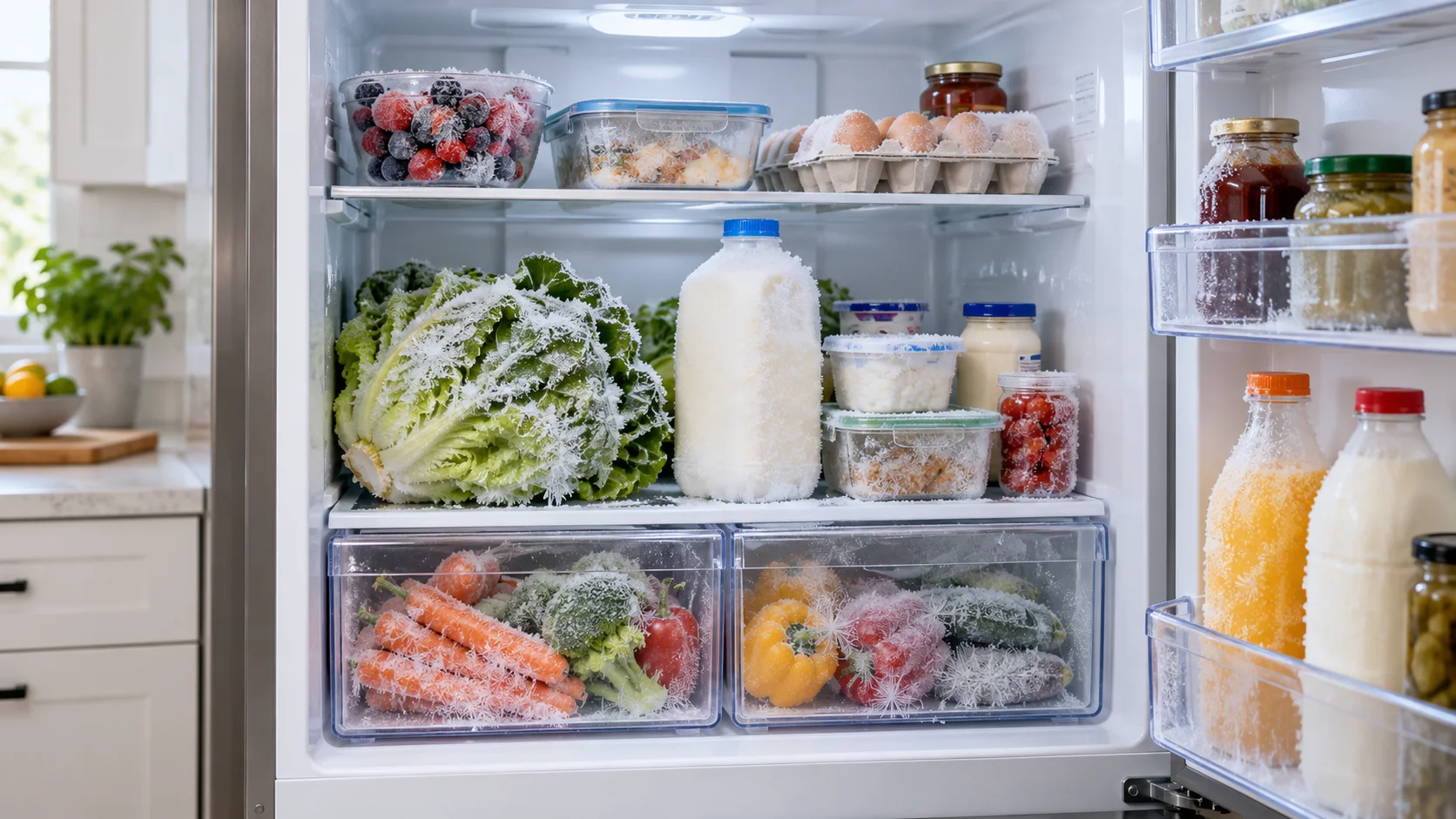
Why is my refrigerator freezing food? Common causes include a temperature setting that is too cold, groceries placed directly in front of cold-air vents, restricted airflow, or a problem with the refrigerator's temperature controls.
Your refrigerator should keep milk, vegetables, and other fresh groceries cold without freezing them. If food starts developing ice crystals or produce freezes in the crisper drawer, something may be affecting the temperature inside the fresh-food compartment.
Before assuming a component has failed, check the temperature settings, food placement, and actual compartment temperature. These observations may reveal a simple issue. If the problem continues, professional refrigerator repair on Long Island can help identify the underlying cause.
7 Common Reasons Food Freezes in the Refrigerator
Several conditions can cause food to freeze in the refrigerator compartment. Some involve routine settings or storage habits, while others may require a technician to inspect the cooling system.
1. Refrigerator Temperature Is Set Too Low
If the refrigerator temperature is set too low, milk, vegetables, beverages, and other refrigerated items may begin to freeze.
Many refrigerators use approximately 37°F (3°C) as a recommended starting setting, although the correct configuration depends on the manufacturer and model.
Check the display or temperature control. A setting that is too cold may explain why groceries are freezing throughout the compartment.
Make small adjustments according to your owner's manual rather than changing the setting dramatically.
2. Food Is Too Close to an Air Vent
Cold air enters the refrigerator compartment through vents, often located along the back wall or sides.
Groceries placed directly in the path of this airflow may become colder than items elsewhere in the refrigerator.
For example, a carton of milk or a bag of leafy vegetables positioned close to an air outlet may partially freeze even when the overall compartment temperature appears normal.
Try moving sensitive items away from the vents while keeping enough space for air to circulate.
3. Restricted Air Circulation
A tightly packed refrigerator can prevent cold air from circulating evenly.
Blocked vents, overcrowded shelves, and large containers positioned against the back wall may contribute to uneven temperatures.
This can create colder areas where food freezes while other sections remain at more typical refrigeration temperatures.
Arrange groceries so that cold air can circulate through the compartment. Do not cover air outlets or pack shelves so tightly that airflow is restricted.
4. Refrigerator Damper or Airflow Control Problems
Some refrigerator models use a damper to regulate how much cold air enters the fresh-food compartment from the freezer.
If the airflow-control mechanism does not operate correctly, excessive cold air may enter the refrigerator section.
This can sometimes contribute to food freezing even when the displayed temperature setting looks appropriate.
However, not every refrigerator uses the same airflow system, and frozen food alone does not confirm a defective damper.
A technician may need to evaluate the mechanism.
5. Temperature Sensor or Thermistor Problems
Refrigerators may use temperature sensors, sometimes called thermistors, to help electronic controls monitor internal conditions.
If a sensor provides inaccurate information, the refrigerator may not regulate its cooling operation as intended.
This can potentially contribute to temperatures becoming lower than expected.
However, a refrigerator freezing food does not automatically mean the thermistor has failed. Temperature settings, airflow patterns, and other operating conditions should also be considered.
Professional diagnosis can determine whether a sensor-related problem exists.
6. Door Seal or Operating Condition Issues
The refrigerator's operating environment can affect how its cooling system behaves.
Damaged door seals, frequent door openings, heavy food loading, or unusually warm surrounding temperatures may change cooling patterns and operating cycles.
These conditions do not necessarily cause food to freeze, but they can contribute to unstable temperatures or expose an existing regulation problem.
Inspect the visible door gasket for gaps, damage, or debris and confirm that the door closes completely.
If a damaged door seal is also causing condensation or moisture buildup, our guide explaining why your refrigerator is leaking water covers those related symptoms and safe checks.
7. Control Board or Other Temperature-Regulation Faults
In some cases, persistent overcooling may involve electronic controls or other components responsible for regulating refrigerator temperature.
A control-related problem can affect how the appliance responds to sensor readings and cooling demands.
The exact system differs between refrigerator models, so there is no single component that explains every case of frozen food.
If groceries repeatedly freeze despite appropriate settings and unobstructed airflow, professional inspection may be necessary.
Avoid attempting electrical control repairs without proper training.
Why Are Vegetables Freezing in My Refrigerator Drawer?
Refrigerator freezing vegetables is a common concern, especially when leafy greens, cucumbers, or other fresh produce develop ice crystals inside a crisper drawer.
Crisper drawers are designed to help preserve produce, but their temperature can be affected by the refrigerator's airflow pattern, drawer placement, and overall cooling conditions.
Some models also include separate temperature-controlled deli or produce compartments with adjustable settings. These controls may affect how cold certain storage areas become.
If vegetables freeze while other groceries remain normal, check whether the drawer is positioned correctly and whether nearby air outlets are blocked.
Try relocating sensitive produce away from unusually cold areas and review any model-specific drawer settings.
If food freezing in the refrigerator continues despite these adjustments, the problem may involve more than ordinary food placement.
Moving vegetables can reduce exposure to a cold spot, but it will not resolve a malfunctioning temperature-control component.
What Temperature Should a Refrigerator Be Set To?
A refrigerator that is too cold can freeze groceries, while one that is too warm may allow harmful bacteria to grow.
Many manufacturers recommend starting around 37°F (3°C) for the fresh-food compartment and 0°F (-18°C) for the freezer. Your refrigerator's manual should guide the exact settings.
The U.S. Food and Drug Administration recommends maintaining refrigerator temperatures at 40°F (4°C) or below for safe food storage.
Importantly, the number on the refrigerator's display may represent a target setting rather than the actual temperature throughout the compartment.
Use a refrigerator thermometer to measure conditions inside the fresh-food section. Check the reading after the refrigerator has had time to stabilize and compare different locations if freezing affects only one area.
If the measured temperature is too low, make small adjustments according to the manufacturer's instructions.
Never raise the refrigerator temperature above safe food-storage limits simply to stop groceries from freezing.
Safe Checks When Your Refrigerator Keeps Freezing Food
If your refrigerator keeps freezing food, begin with these homeowner-friendly checks before considering internal component problems.
1. Confirm the temperature setting.
Review the fresh-food temperature control and compare it with the recommended setting in your owner's manual.
2. Measure the actual temperature.
Place a refrigerator thermometer inside the compartment. Use its readings to determine whether the overall temperature is too low or whether freezing occurs mainly in one area.
3. Move groceries away from air vents.
Keep milk, vegetables, and other sensitive items away from direct cold-air outlets.
4. Check for blocked vents.
Look for containers or food packages obstructing visible air openings. Do not remove protective panels.
5. Avoid overcrowding shelves.
Leave space between stored items so air can circulate.
6. Inspect the visible door gasket.
Check for obvious damage, debris, or gaps that may interfere with proper door closure.
7. Review model-specific settings.
If your refrigerator has adjustable drawers or separate temperature-controlled storage zones, review their settings in the owner's manual.
8. Allow time after adjustments.
Many models need approximately 24 hours for temperatures to stabilize after a setting change. Follow the manufacturer's guidance and monitor the thermometer.
These checks can help identify simple storage or setting problems without opening the appliance.
Do not remove electrical panels, bypass sensors, handle refrigerant lines, or attempt internal control repairs.
For other refrigerator problems beyond food freezing, explore our refrigerator troubleshooting guides, which cover cooling issues, unusual noises, and water leaks.
Why Is My Refrigerator Freezing Food Even After Adjusting the Temperature?
If food continues freezing after you have selected an appropriate temperature and improved airflow, the refrigerator may not be regulating its internal conditions correctly.
First, determine whether the problem affects the entire fresh-food compartment or only one shelf or drawer.
A localized cold spot may be associated with air-vent placement or uneven circulation. Widespread freezing despite an appropriate setting raises different concerns about temperature regulation.
Possible areas for professional evaluation include airflow-control mechanisms, temperature sensors, electronic controls, and other model-specific components.
Also pay attention to inconsistent temperatures. A refrigerator that alternates between freezing groceries and failing to keep food cold may require a broader cooling-system evaluation.
For information about the opposite symptom, read our guide explaining why your refrigerator is not cooling.
Persistent overcooling should be diagnosed rather than attributed to a specific part without testing.
When Should You Schedule Refrigerator Repair?
A single frozen item near a cold-air vent does not necessarily indicate a mechanical failure.
However, professional inspection may be appropriate when:
- Food repeatedly freezes despite reasonable temperature adjustments.
- Multiple areas of the fresh-food compartment become excessively cold.
- Thermometer readings consistently show temperatures lower than expected.
- The refrigerator alternates between freezing groceries and insufficient cooling.
- Unusual noises, control problems, or other symptoms accompany the freezing.
If unusual sounds occur alongside inconsistent cooling, our guide on why your refrigerator is making noise explains common operating sounds and warning signs that may require attention.
A technician can examine temperature regulation, airflow operation, and relevant components to identify the underlying issue.
An accurate diagnosis helps determine whether the issue requires a component repair or a simpler adjustment.
Frequently Asked Questions About Refrigerators Freezing Food
Why is my refrigerator freezing everything?
If your refrigerator is freezing everything in the fresh-food compartment, the temperature may be set too low or the cooling system may not be regulating temperatures properly. Check the settings and measure the actual temperature. Widespread freezing that continues after reasonable adjustments may require professional diagnosis.
What temperature should my refrigerator be to prevent food from freezing?
Many refrigerators use approximately 37°F (3°C) as a recommended fresh-food setting. The actual compartment temperature should remain at or below 40°F (4°C) for food safety without routinely dropping to freezing levels. Use a refrigerator thermometer and consult your appliance manual before adjusting the controls.
Why are vegetables freezing in my refrigerator drawers?
Vegetables may freeze because of unusually cold airflow, drawer placement, inappropriate temperature settings, or a problem with temperature regulation. Some refrigerators also have adjustable drawer controls. Check the drawer settings and nearby vents. If freezing continues, further inspection may be necessary to identify the cause.
Can blocked air vents cause food to freeze in the refrigerator?
Yes. Blocked vents can interfere with normal airflow and contribute to uneven temperatures. In addition, food positioned directly in front of a cold-air outlet may freeze. Keep vents unobstructed and allow sufficient space between groceries. Persistent freezing can indicate a separate temperature-regulation problem.
Can a faulty temperature sensor make a refrigerator too cold?
Yes. An inaccurate temperature sensor or thermistor can potentially affect how the refrigerator regulates cooling. However, frozen food does not prove that a sensor is defective. Incorrect settings, airflow problems, and other components may produce similar symptoms. A technician can perform the necessary diagnostic checks.
When should I call a technician if my refrigerator keeps freezing food?
Consider scheduling service when food repeatedly freezes despite appropriate settings, unobstructed vents, and reasonable storage adjustments. Consistently abnormal thermometer readings or alternating freezing and poor cooling also deserve attention. A technician can identify whether the problem involves airflow, temperature sensing, or another refrigerator component.
Refrigerator Freezing Food? Schedule a Professional Inspection
If your refrigerator continues freezing groceries despite reasonable temperature and airflow checks, Technical Appliance Service LLC can help identify the underlying problem.
We provide residential refrigerator repair throughout Nassau County and selected Suffolk County communities on Long Island. Explore our appliance repair service areas to learn more about our coverage.
Call 929-585-2342 or contact Technical Appliance Service LLC to discuss the symptoms and appointment availability.