
Dryer Not Drying Clothes? Heat, Airflow or Load Problem?
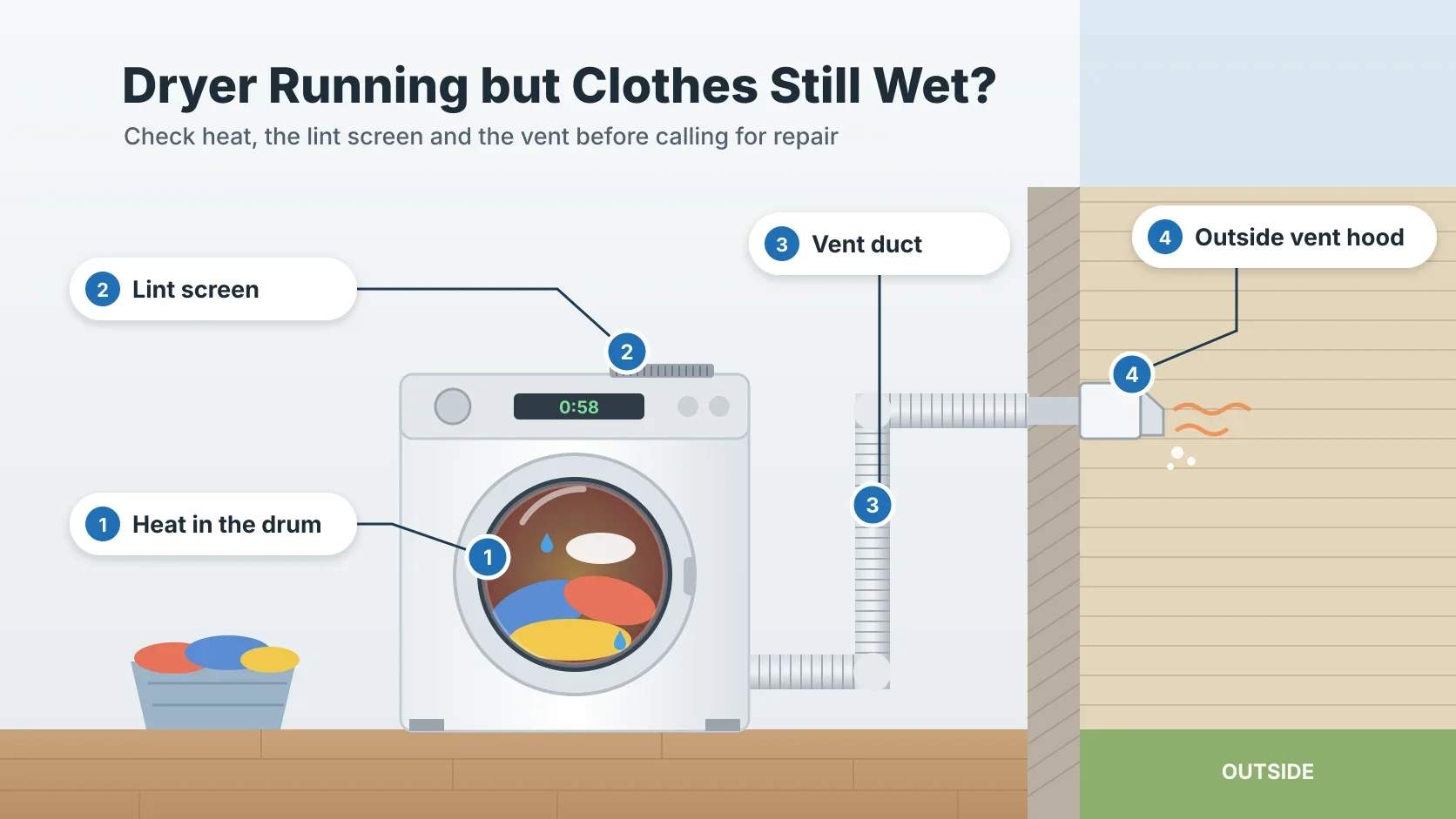
When a dryer runs but the clothes stay damp, the cause is usually one of three things: the dryer is not heating, hot air cannot leave through the vent, or the load itself is the problem. Two quick checks, one inside the drum and one at the outside vent, tell you which one you are dealing with.
This guide walks you through those checks, the most common causes, and the point where a clogged vent or a failed part needs professional attention.
Start Here: Is It Heat, Airflow or the Load?
Do these two checks before anything else. Each takes about five minutes.
- Heat check. Empty the dryer, start a heated cycle and let it run for 5 minutes. Then open the door and feel inside the drum. It should feel clearly warm.
- Airflow check. Start the dryer again and go outside to the vent hood, the cover where the dryer duct exits the house. Hold your hand under it. You should feel a steady stream of warm air, and the flap should open.
Match what you found to the table below.
| What you notice | Likely problem area | What to do next |
|---|---|---|
| Drum stays cold on a heated cycle | Heat: thermal fuse, heating element, gas igniter or power supply | Check the cycle setting and breaker, then call a technician |
| Drum is hot, but little or no air at the outside hood | Airflow: lint in the vent, crushed duct, blocked hood | Clean the lint screen; have the vent cleaned |
| Drum is hot and airflow is strong, but clothes stay damp | Load or settings: overloaded drum, very wet clothes, wrong cycle | Smaller loads; check the washer's spin; review the cycle |
| Cycle ends early and clothes are still damp | Moisture sensor or dryness setting | Clean the sensor bars; raise the dryness level |
| Drum does not turn, but you hear the motor | Drive belt or drum support parts | Stop using it and schedule a repair Example: drive belt replacement in Westbury |
| Dryer or clothes are very hot, or you smell burning | Severe airflow restriction or a part overheating | Stop the dryer now; see our guide to a burning smell from the dryer |
9 Common Reasons Your Dryer Is Not Drying
1. Clogged Lint Screen
A full lint screen is the simplest cause. Lint blocks the air path, so warm, moist air stays inside the drum. Dryer sheets can also leave an invisible film on the mesh that slows airflow even when the screen looks clean.
What to do: clean the lint screen before every load. If water beads on the mesh instead of passing through, wash it with warm water and a soft brush, then let it dry completely before you put it back.
2. Restricted or Crushed Vent Duct
The duct behind the dryer carries hot, damp air outside. Lint builds up inside it over time, and a duct that is crushed behind the machine or has too many bends slows the airflow even more. Maytag recommends rigid or flexible metal duct, at least 4 inches wide, with no more than four 90-degree bends. Plastic or foil duct is easily crushed and not recommended.
What to do: pull the dryer out gently and check that the duct is not kinked or flattened. If airflow at the outside hood is weak, have the full vent run cleaned. Ducts that run through a wall, a ceiling or the roof are best handled by a dryer vent cleaning professional.
3. Blocked Outside Vent Hood
Even a clean duct cannot work if the exit is blocked. Lint, leaves, a stuck flap or a bird nest can close off the vent hood. In winter, check that snow is not covering it.
What to do: with the dryer off, look at the outside hood and clear anything you can reach safely. The flap should move freely.
4. The Drum Is Overloaded
Clothes need room to tumble so warm air can pass through them. An overloaded drum, or a load that mixes heavy towels with light shirts, leaves some items damp at the end.
What to do: dry one wash load at a time, and dry heavy items such as towels and jeans separately from lighter fabrics.
5. Clothes Are Too Wet From the Washer
If clothes come out of the washer dripping, the dryer has far more water to remove. This often points to a washer that did not finish its spin.
What to do: squeeze a towel after the wash. If water runs out, the washer is the problem, not the dryer. Read our guide to a washer that is not spinning properly.
6. Wrong Cycle or Dryness Setting
Air Fluff and similar no-heat cycles tumble the clothes without heating them. A low dryness level on a sensor cycle can also end the cycle while some items are still damp.
What to do: choose a heated cycle that matches the fabric, and raise the dryness level if loads often finish damp.
7. Dirty Moisture Sensor Bars
Many dryers have two metal bars inside the drum, usually near the lint screen, that sense how wet the load is. Fabric softener residue on these bars can make the dryer think the load is dry, so it stops too early.
What to do: with the dryer off, wipe the bars with a soft cloth and a little rubbing alcohol, or follow the cleaning steps in your owner's manual.
8. The Dryer Is Not Heating
If the drum stays cold, the dryer cannot dry. Common causes include a blown thermal fuse, a failed heating element on an electric dryer, or an igniter or gas valve problem on a gas dryer. On many electric dryers, a tripped half of the double breaker lets the drum turn while the heater stays off.
What to do: check the cycle setting and the breaker panel. If the dryer still does not heat, schedule a repair. A thermal fuse often blows because of a vent restriction, so the vent should be checked at the same visit. For an example from our work, see this dryer that was not heating in Hampton Bays.
9. Cold Laundry Room
Dryers do not work well in very cold spaces. Maytag notes that dryer cycles need a room temperature above 45°F. On Long Island, laundry in an unheated garage or basement can take noticeably longer in January and February.
What to do: if loads only dry slowly in winter and the dryer heats normally, the room temperature may be the reason. Keep the door to the laundry area open or warm the space if you can.
Why a Clogged Dryer Vent Is a Safety Problem
Slow drying is often the first sign of a vent full of lint, and lint burns easily. The U.S. Fire Administration estimates that about 2,900 clothes dryer fires in homes are reported each year, and failure to clean was the leading factor, at 34% of those fires.
- Clean the lint screen before every load.
- Have the duct and vent run inspected and cleaned at least once a year.
- Do not run the dryer while you are away from home or asleep.
- Stop using it if the top of the dryer or the clothes feel unusually hot.
What Not to Do
- Do not keep running cycle after cycle on a dryer that is not heating. It wastes energy and can hide an airflow problem.
- Do not use plastic or foil vent duct.
- Do not open the dryer cabinet with the power connected.
- If you smell gas, do not use the dryer or any switches. Leave the house and call your gas utility.
When to Call a Technician
Schedule a repair if any of these apply:
- The drum stays cold on heated cycles.
- Airflow is strong and the load is normal, but clothes still need two cycles.
- The drum does not turn, or the dryer makes grinding or thumping noises.
- The dryer stops before the cycle ends.
- The dryer trips the breaker or you notice a burning smell.
On a service visit, a technician tests the heating circuit, the thermal fuse and safety thermostats, the blower and the drive system. You get the price before any repair starts. If the vent itself is blocked, we will tell you, so you can have it cleaned before the dryer is used again.
Is It Worth Fixing a Dryer That Won't Dry?
Usually, yes, when the dryer is in good condition. Many causes are airflow or settings problems that cost little or nothing to fix, and parts such as a thermal fuse or a belt are common repairs. Replacement deserves a closer look when the dryer is old, the drum or motor has failed, or it has needed several major repairs. A diagnosis gives you the cause and the repair price before you decide.
Dryer Repair on Long Island
Technical Appliance Service repairs residential gas and electric dryers across all of Nassau County and selected communities in Suffolk County. If your dryer runs but does not dry, we can find out whether the problem is heat, airflow or a failed part. The $90 diagnostic fee is waived when you go ahead with the repair. Learn more about our dryer repair on Long Island, or call (929) 585-2342 to schedule service.
Frequently Asked Questions About a Dryer Not Drying
Why are my clothes still wet even though my dryer is hot?
A hot dryer that does not dry usually has an airflow problem. The heat is there, but the moist air cannot leave because of a full lint screen, a clogged or crushed vent duct, or a blocked outside vent hood. An overloaded drum can cause the same result.
Why does my dryer take 2 or 3 cycles to dry?
The most common reasons are a restricted vent, a load that is too large, or clothes that come out of the washer too wet. If the dryer also feels only lukewarm, a heating part may be failing. Start with the lint screen and the airflow check at the outside vent.
How do I know if my dryer vent is clogged?
Common signs are longer drying times, a dryer or clothes that feel unusually hot, a burning smell, and weak airflow at the outside vent hood. Run the dryer and hold your hand under the hood. You should feel a steady stream of warm air.
How often should a dryer vent be cleaned?
Clean the lint screen before every load, and have the full duct and vent run inspected and cleaned at least once a year. Homes with long vent runs or heavy laundry use may need it more often.
How do I tell if my dryer has a blown thermal fuse?
On many dryers, a blown thermal fuse means the dryer will not heat, and on some models it will not start at all. A technician confirms it with a meter. Because the fuse often blows when the vent is restricted, the airflow should be checked before the dryer is used again.
Does unplugging a dryer reset it?
On some dryers with electronic controls, disconnecting power for a few minutes can clear a temporary control error. It will not fix a blown fuse, a failed heating element or a clogged vent. Follow the reset steps in your owner's manual.
Is it worth fixing a dryer that doesn't heat?
Often, yes. Common causes such as a thermal fuse, a heating element or a gas igniter are standard repairs. Replacement makes more sense if the dryer is old, has needed several major repairs, or the drum or motor has failed. At Technical Appliance Service, the $90 diagnostic fee is waived when you go ahead with the repair.